

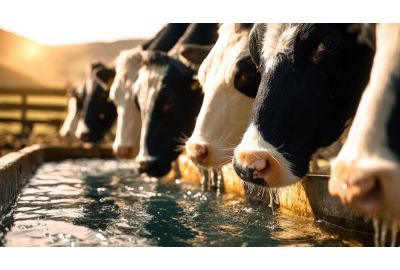

Hook: Water is one of the most important nutrients, but do you know the quality of the water on your farm? Clean, high-quality water boosts milk production, animal health and growth. Test your water quality and consider water treatment options such as chlorine dioxide to enhance profitability.
Water is one of the most important nutrients for livestock, yet water quality is easy to overlook. A cow producing 100 pounds of milk per day requires approximately 40 gallons of water daily, with even higher demands in hot weather. Pre-weaned calves only need 1-2 gallons of water per day, but since starter intake is closely linked to water consumption, water is equally important to maximize average daily gain. While a portion of an animal’s daily water requirement is met via the diet, most comes from drinking water. Maximizing water consumption by having adequate availability of clean, high-quality water boosts milk production, animal health and growth. Awareness of your farm’s water quality allows you to take appropriate steps to enhance profitability.
Simply defined, water quality is the chemical and physical characteristics of water that impact animal health and performance, especially minerals, salts, heavy metals, pollutants and microbial contaminants. Total dissolved solids (TDS) is the sum of all inorganic contaminants. TDS levels above 3,000 mg/L are more likely to cause an unpleasant taste that limits water intake. High iron, manganese and hydrogen sulfide in particular cause a disagreeable taste and/or odor. These compounds can also plug waterlines, limiting water availability. Very high nitrate-nitrogen levels decrease fertility and average daily gain.
Microbial contamination of livestock waterers occurs as animals drink. Bacteria then spread from the drinker into the water line, further compounding bacterial levels. E. coli and Salmonella are the most common bacteria found, along with algae in waterers exposed to sunlight. These microorganisms create a biofilm that protects them from many common detergents, making it even more difficult to fully clean waterers.
Water testing is an inexpensive way to evaluate water quality. Some labs provide livestock-specific water quality analyses. Your local extension office can share reliable testing facilities. Water should be tested at least once every five years as quality can change over time. Take samples from close to the water source as well as from multiple drinkers to capture a full picture of your farm’s water quality.
If water quality is poor, multiple treatment options exist dependent on the contaminant. Reverse osmosis, the most expensive option, removes many minerals. Water softeners reduce sulfates, nitrates and TDS by exchanging those compounds with sodium.
Disinfection is necessary to address bacteria in the water. Chlorine is commonly used due to its availability and low cost. Some farmers will “shock” a well with a high level of chlorine to kill bacteria and reduce bacterial buildup in water lines. However, one-time chlorination does little to address the ongoing contamination of waterers. Similarly, scrubbing and disinfecting stock tanks cannot touch bacteria in the water line.
Many farms are turning to a chlorine dioxide system to decrease water bacterial levels. Chlorine dioxide is broad-spectrum disinfectant effective at a wide pH range. It reduces bacterial levels, kills Cryptosporidium and controls biofilm buildup in water lines and waterers. It destroys iron-producing bacteria as well, decreasing iron odors in the water. Chlorine dioxide, at the proper level, is safe for animals and is less corrosive than chlorine.
If it’s been years since your water quality was tested, now is a great time. Work with your veterinarian on water sample collection and discuss if chlorine dioxide is an option for your farm.
Written by Dr. Vicky Lauer, Chief of Veterinary Services at Armor Animal Health. Dr. Lauer may be reached at [email protected].
![Aquaprime Activator [55 Gallon]](https://dev2.armoranimalhealth.com/media/catalog/product/cache/f9d733986910da5c204c78cc04e31f9b/_/a/_a_q_aquaprime_activator_55_gallon_.jpg)
![Aquaprime Neoklor [55 Gallon]](https://dev2.armoranimalhealth.com/media/catalog/product/cache/f9d733986910da5c204c78cc04e31f9b/_/a/_a_q_aquaprime_neoklor_55_gallon_.jpg)
![Dutrion Tab [20 gm] (250 Count)](https://dev2.armoranimalhealth.com/media/catalog/product/cache/f9d733986910da5c204c78cc04e31f9b/_/1/_1_5_15397.jpg)


